

Patterning Description
Continuous Filament Architecture | Bradford C. Jamison | TEF Braids
Conventional braiding begins with two groups of filaments traveling in opposing directions. As these filaments cross over and under one another, they form an interconnected textile structure.
TEF Braids extends this fundamental principle through programmable sequences of crossing, interlacing, and linking, creating a diverse family of continuous-filament architectures.
These structures are defined by the relationships between individual filaments, the direction of their movement, and the frequency and sequence of their interactions.
Crossing, Interlacing, and Linking
Crossing (X)
A crossing occurs when one filament passes over or under another filament. This is the fundamental interaction in conventional braided textiles.
Interlacing
Interlacing occurs through successive over-and-under crossings between filaments. These interactions create an organized textile structure while allowing relative movement between filament members.
Linking (2X)
A link occurs when two filaments cross one another twice consecutively, creating a mechanical connection in which the filament paths wrap around one another.
Unlike a simple crossing, linking establishes a more direct structural relationship between neighboring filaments, facilitating the distribution of tension throughout the textile.
The incorporation of repetitive links distinguishes TEF Braids' patented architectures from conventional braiding.
Programmable Crossing Intervals
The number of filaments crossed before establishing a link determines the geometry and characteristics of the resulting textile.
2X — Link
Two consecutive crossings between filament members create a link. Repeated links form spiraling filament relationships and interconnected textile structures.
2X + 1
A filament crosses one additional filament before establishing its next link. This introduces an interlaced interval between successive linked interactions.
2X + 2
Two filaments are crossed before the next link. The increased interval creates a different arrangement of linked and interlaced members, altering the resulting geometry.
2X + 3
Three filaments are crossed before establishing the next link, producing a wider interval between linked interactions.
These programmable variations generate different degrees of openness, density, expansion, and conformal behavior.
3X — Wrapping
Wrapping introduces an extended filament interaction, illustrated by three successive crossings.
The resulting filament paths wrap around neighboring members, creating another means of organizing and connecting filaments within a continuous structure.
The distinction between crossing, linking, and wrapping provides a vocabulary for understanding how individual filament movements produce increasingly complex architectures.
Bobbinet | 3X + 1
Brad's Bobbinet illustration combines extended linking or wrapping interactions with additional filament crossings.
The resulting structure features regularly spaced, spiraling filament groups connected through intermittent crossing members.
This arrangement creates an open, organized geometric textile in which the spacing and relationships between connected filament groups can be programmed.
Trilateral Architecture | X, Y, and Z
Conventional biaxial braids generally organize filaments along two opposing directions.
Trilateral architectures introduce a third directional relationship, identified in Brad's illustrations as the X, Y, and Z axes.
The illustrated trilateral construction combines spiraling filament members with a third group of crossing filaments.
This additional direction creates opportunities for controlling structural density, filament interaction, and the distribution of tension through the textile.
XHelX | Linked and Interlaced Architecture
The XHelX family combines different linking intervals within opposing groups of filaments.
Brad's illustrated XHeliX construction combines 2X + 3 and 2X + 1 sequences, establishing an organized relationship between linked and interlaced filament members.
The opposing X and Y filament groups interact through a repeating arrangement of linked and interlaced crossings.
This combination produces a unified textile architecture in which tension can be distributed through interconnected filament pathways.
By varying the intervals and sequences of these interactions, XHelX patterns can exhibit different geometries, densities, expansion characteristics, and conformal properties.
The XHelX family demonstrates how programmable filament relationships can generate structurally distinct textiles without relying solely on changes in yarn material or conventional weave patterns.
U.S. Patent 10,159,297
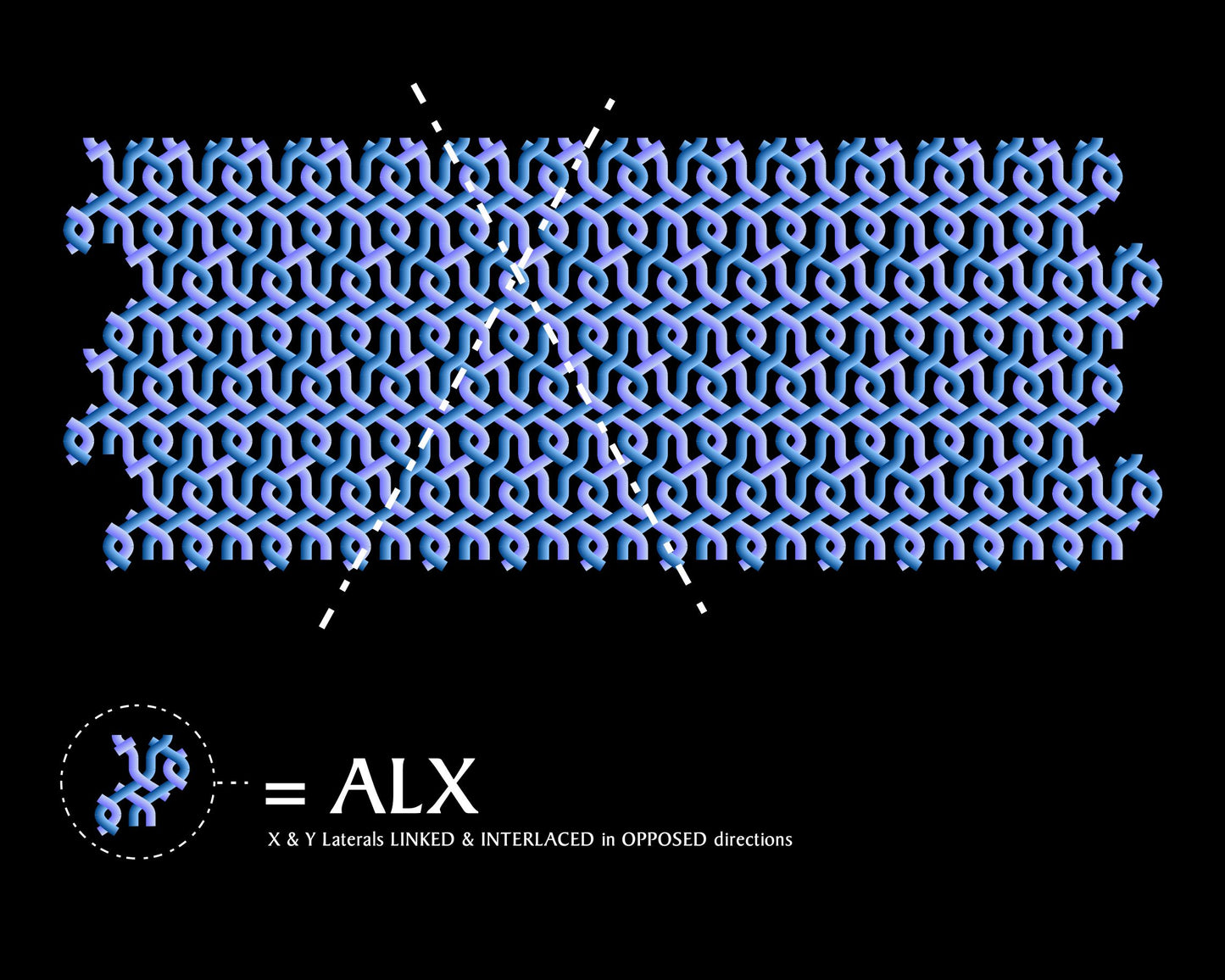
ALX | Interconnected Double-Helix Architecture
The ALX family develops the principle of filament linking into an architecture of interconnected double helices.
Pairs of filaments spiral around one another, forming linked helical structures. These filament pairs travel in opposing directions and interact with neighboring groups through additional linking and interlacing.
Brad's illustrations distinguish the ALX architecture through X and Y laterals that are both linked and interlaced in opposed directions.
The resulting textile is not simply a collection of independent helical pairs. Its linked and interlaced filament relationships create an interconnected structure capable of distributing tension among neighboring members.
This architecture is designed to provide enhanced conformity to three-dimensional surfaces, expansion, and constrictive behavior.
Programmable variations within the ALX family allow changes in density, geometry, and filament interaction while maintaining the underlying principles of linked double-helix construction.
U.S. Patent 10,905,188
From Pattern to Performance
The structural behavior of these textiles emerges from the relationships between their filaments.
By programming the sequence, frequency, and direction of crossings, links, and interlacings, TEF Braids can create continuous textile architectures with different mechanical and aesthetic characteristics.
These characteristics include:
-
Expansion: The ability of a textile to change dimensions through the rearrangement of its filament geometry.
-
Conformity: The capacity to accommodate curved and complex three-dimensional surfaces.
-
Constrictive behavior: The development and distribution of tension as the textile is expanded or subjected to loading.
-
Density: Control over the concentration and arrangement of filaments within the structure.
-
Pattern variation: The creation of distinct geometric surfaces through programmable filament movements.
Actual performance also depends on yarn selection, filament dimensions, machine settings, and the finished construction.
A New Language of Textile Architecture
The fundamental innovation is the ability to program relationships between continuous filaments.
Rather than relying exclusively on material composition or surface decoration, TEF Braids develops textile structures through the geometry of their individual filament pathways.
Crossing, interlacing, linking, and wrapping become elements of a programmable structural vocabulary.
From open, expandable lattices to dense, interconnected double-helix constructions, these principles provide a foundation for exploring textiles that combine geometry, conformity, and structural function.
For footwear, handbags, apparel, and other engineered applications, the textile can become an integral part of the object's form rather than simply a material applied to its surface. The pattern is the architecture.